Rising Edge Digital • Hardware & Embedded Systems for Software Developers
The Raspberry Pi as a Studio Camera · Adafruit SGP41 Multi-Pixel Gas Sensor Breakout · Professor Bubbleton’s Breathing Head in a Jar

The Raspberry Pi as a Studio Camera
The article discusses a project by Martijn Braam, who is building a studio camera using a Raspberry Pi 5, touchscreen, and an HD camera module. The setup is housed in a basic wooden box, but the highlight of the project is the custom software he developed. This software creates a low-latency graphical user interface (GUI) that outputs via HDMI, allowing one output to show the GUI and another to display the raw video feed. This design is particularly useful for integrating with video mixing equipment, like OBS Studio.

Professor Bubbleton’s Breathing Head in a Jar
Professor Bubbleton’s Breathing Head in a Jar is a quirky project that combines art and technology to create a captivating display for your curiosities cabinet. The project uses a Circuit Playground Express (CPX) microcontroller along with an air pump and CircuitPython code to animate a 3D printed head that glows and simulates breathing bubbles when tapped.

Open-source Real-time Driver MOD for the LEGO Orrery
Görkem Bozkurt has created an open-source modification for the LEGO Orrery, which is a model that illustrates the positions of celestial bodies in the solar system. This mod features a custom printed circuit board (PCB) that can be directly affixed to a NEMA17 stepper motor. By replacing the manual crank with this setup, users can control the Orrery’s movement with ease, only needing to remove five LEGO pieces to install it.
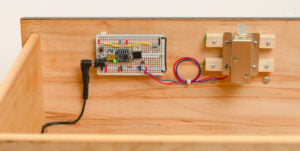
Secret Knock Activated Drawer Lock
The Secret Knock Activated Drawer Lock is a fun DIY project that allows you to unlock a drawer using a specific pattern of knocks. Instead of a traditional key, this lock utilizes a hidden mechanism that responds to a sequence of taps, making it discreet and engaging. A solenoid latch secures the drawer, while a piezo buzzer detects the knock pattern. A small microcontroller, the Trinket, processes the knocks and compares them to a pre-set secret pattern to grant access.

NEW GUIDE: Adafruit SGP41 Multi-Pixel Gas Sensor Breakout
The Adafruit SGP41 Multi-Pixel Gas Sensor Breakout is a sophisticated air quality sensor designed to measure both volatile organic compounds (VOCs) and nitrogen oxides (NOx). This sensor, developed by Sensirion, integrates multiple metal-oxide sensing and heating elements into one chip, eliminating the need to handle the heater and analog readings manually. The breakout uses I2C (Inter-Integrated Circuit) for communication, making it straightforward to connect to a variety of microcontrollers.
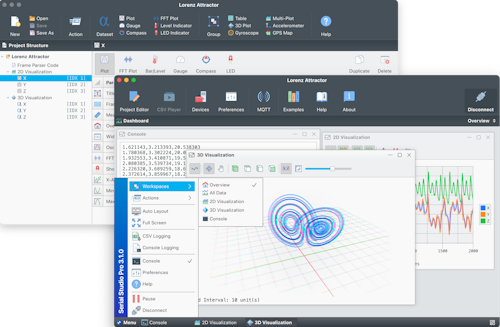
Serial Studio: see data from Arduino, ESP32, Raspberry Pi, and other devices in real-time
Serial Studio is a versatile tool that allows you to visualize data from various devices like Arduino, ESP32, and Raspberry Pi in real-time. It supports multiple communication protocols, including serial ports (UART), Bluetooth Low Energy (BLE), and TCP/UDP networks. You can create custom dashboards to monitor sensors and troubleshoot hardware without needing to write any code.

This LEGO alarm clock is as loud as a rocket launch
Milos Rasic created a unique alarm clock using LEGO's NASA Artemis Space Launch System kit, which is designed to be as loud as a rocket launch. The project involves a 3D-printed launch pad that houses an Arduino UNO R4 WiFi board, which controls the clock and the alarm function. The board displays the time on an LED matrix and operates a stepper motor to simulate the rocket launch mechanism.
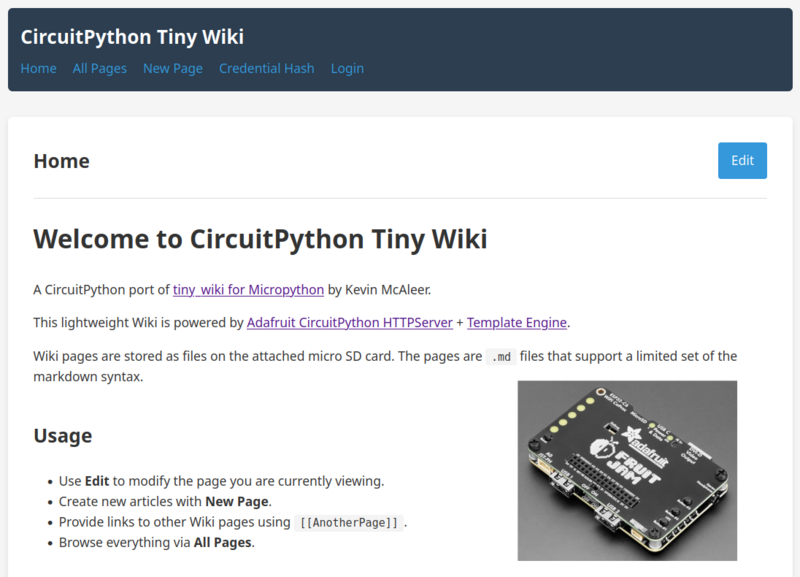
NEW LEARN GUIDE: Tiny Wiki for CircuitPython
Tiny Wiki is a lightweight web server designed to run on microcontrollers, providing a minimalistic Wiki system backed by markdown files. Originally developed by Kevin McAleer for MicroPython devices, this guide introduces a version tailored for CircuitPython, specifically using Adafruit's HTTPServer and TemplateEngine libraries. While it was designed for the Adafruit Fruit Jam, it can also be adapted for other CircuitPython devices equipped with WiFi and a microSD card.

Creating the World’s Most Efficient Quadcopter Drone
[Luke Maximo Bell] is working on creating the world's most efficient quadcopter drone, aiming to break the endurance record currently held at 3 hours and 11 minutes. Inspired by his previous experience with a solar-powered quadcopter, he is focused on maximizing performance per watt, which involves a careful balance of weight, power output, and design.
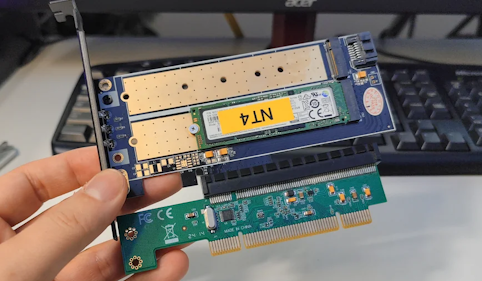
Putting a modern NVMe SSD drive on a vintage computer PCI bus
O_MORES on Reddit has come up with a clever solution to connect a modern NVMe solid-state drive (SSD) to a vintage computer that only has PCI (Peripheral Component Interconnect) slots. The process involves using an M.2-to-PCIe Add-in Card (AIC) to house the NVMe SSD. This AIC is then inserted into a PCIe-to-PCI adapter, allowing it to fit into the older PCI slot on the motherboard. Although PCI and PCIe have different pinouts and are physically distinct, they can be used together because they are logically compatible.
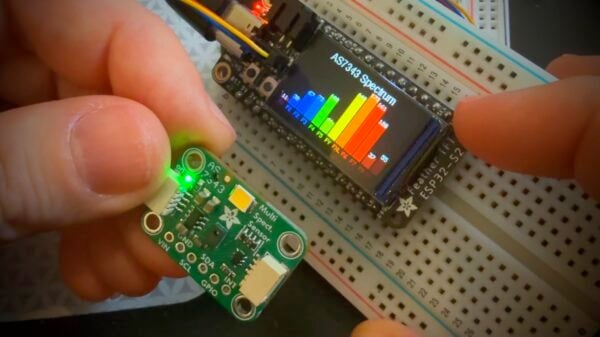
Coming Soon – Adafruit AS7343 14-Channel Multi-Spectral Sensor Breakout
The Adafruit AS7343 is a new 14-channel multi-spectral sensor breakout that enhances the capabilities of its predecessor, the AS7341. This updated version now includes 12 channels that range from visible light into near-infrared (380nm to 1000nm), along with clear and flicker detection. It maintains the same footprint and pinout as the AS7341, making it easy to integrate into existing projects without needing to modify wiring or enclosures.